AI Takeoff
Email us the bid set. Get marked up plans and specs in 15 minutes.
Drive more bids with the same headcount.
Streamline reads your P&IDs, control narrative, and I/O list, pulls the equipment, instruments, and points into a structured takeoff, and marks up the process drawing with tags and counts. Your estimator opens a prepped bid instead of a blank sheet.
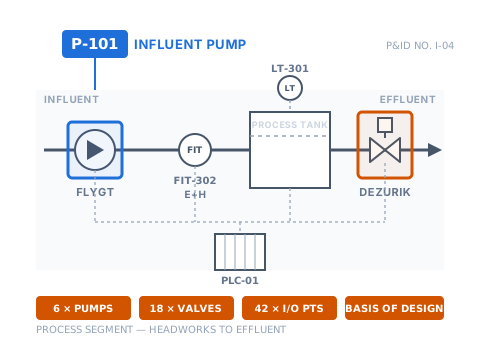
A bid set lands. The clock starts. Most of it goes to markup, not estimating.
If your team estimates water and wastewater controls work, bid prep is costing you speed, deadlines, and bids won — and it has nothing to do with how good your application engineers are.
Most of the time goes to markup, not estimating
Before anyone can price a job, someone walks the P&ID counting pumps, valves, and instruments, then cross-references the control narrative and I/O list against the equipment schedule. That reading and cross-referencing consumes the estimator before the estimate even starts.
Reconciliation gaps get missed
A pump on the P&ID with no controls scope. A sequence that needs tank level with no instrument assigned. A start command with no run-status feedback. A fault in the I/O list that never reaches the alarm schedule. Miss one and you find out in the FAT — or after the number is already in.
Prep time caps how many jobs you can bid
Manual prep doesn't compress, no matter how experienced your engineers are. When three bid sets land the same week, one gets rushed or passed on. Those are invisible losses that compound over a quarter.
Your best application engineers spend hours on the most routine part
The person who can catch a missing interlock and price a pump station correctly is also the one counting I/O points and reconciling tags across the P&ID, equipment schedule, and I/O list. That's where the day goes, before the expertise even kicks in.
Bid set in. Takeoff out. Your estimator prices the job, not the drawings.
Streamline learns your equipment lines and how engineers write P&IDs, control narratives, and I/O lists. It handles the markup so your team can focus on the price.
Bid set comes in
A P&ID, control narrative, I/O list, and equipment schedule land by email or portal. Streamline picks them up and starts reading immediately.
Works with how your team already receives bid documents. No new inbox, no process change.
Requirements extracted and reconciled
Streamline reads the P&ID and process drawings and pulls out equipment, instruments, valves, I/O points, tags, basis-of-design, and quantities — reconciled across the equipment schedule, control narrative, and I/O list.
It recognizes a P&ID by content — equipment tags, piping, instruments, control relationships — not by filename. Device counts and point counts stay separate.
Bid docs prepped for review
The extracted equipment, points, and requirements are mapped into your own takeoff and bid template. Your estimator opens a draft that's already structured and applies judgment.
The AI handles the markup. Your estimator handles the price. Neither steps on the other.
Bid out the door
What used to take hours of markup now takes a fraction of it. Your estimator reviews and submits. More bids, same headcount.
Four weeks from kickoff to go-live. We integrate with your existing estimating and bid tools.
Average time from bid set to prepped takeoff.
The same documents your estimators already read, just without the manual markup.
See Streamline on your next bid
Book a 15-minute demo and we'll show you what your next bid set looks like prepped and ready to quote.
Where Streamline changes the work
The same bottleneck shows up at different points in the bid workflow. Here's what it looks like in practice.
Your engineers spend hours on markup before pricing starts
The situation
A P&ID, control narrative, I/O list, and equipment schedule land. Before anyone can price, someone walks the P&ID counting pumps, valves, instruments, and I/O points, then cross-references the control narrative against the I/O list and equipment schedule. On a full water/wastewater bid set, that's hours before pricing even begins.
What Streamline does
- Reads the P&ID, PFD, control narrative, I/O list, and equipment schedule, extracting what's in your scope
- Pulls equipment, instruments, valves, and I/O points into a structured takeoff with tags and quantities
- Keeps device counts and point counts separate — one pump is a start command, run status, fault, speed command, and feedback
- Marks up the process drawing with identified equipment and counts
The result
Your estimator opens a structured takeoff instead of a blank sheet. The prep is done. They review, price, and submit.
Average time from bid set to prepped takeoff — no manual markup.
Built for how controls bids actually move
Streamline reads the same P&IDs, control narratives, and I/O lists your team works from every day — and reconciles them across documents the way a reviewer would.
Why controls integrators choose Streamline
Implementation is handled by our team, not yours. We learn your systems, your takeoff and bid templates, and how your engineers write P&IDs and control narratives.
We do the work to get you live
You don't configure Streamline yourself. Our team learns how your application engineers work, maps your P&ID conventions and tag formats, and builds the integration. No internal IT project, no months of setup.
Built around your systems, not a generic template
Streamline is trained on your equipment lines, your takeoff and bid templates, and the P&ID conventions and tag formats your engineers actually use. A pump station bid looks nothing like a filtration job — and it won't treat them the same.
Fits into how your team already works
Your engineers don't change their workflow. Bid sets still arrive the same way. Bids still go out the same way. Streamline handles the markup in between.
Your data stays in your environment
Deploy on your infrastructure — on-prem, private cloud, or your VPC. Your bid documents, your pricing, your customer data — none of it leaves your environment.
See Streamline on your next bid
Book a 15-minute demo and we'll show you what your next bid set looks like prepped and ready to quote.